Friday, September 21, 2012

My Head Exploded


Forty six years ago, my head exploded.

The year was 1966. I was a freshman at West Chester State College, beginning my undergraduate training to become an English teacher. I'd just completed four years of an arduous Jesuit education at St. Joseph's Prep. I'd commuted by trolley car, elevated train and subway over 700 times from the suburbs into the streets of North Philadelphia. Police sirens, screeching subway wheels, blaring traffic on Broad Street, and congested concourses underneath City Hall were my white noise while I navigated my way through Latin and French translations, obscure mathematical concepts, and the gobbledy gook of scientific charts and formulas.

Now I found myself in West Chester, PA, 30 miles outside the city, where the sky was blue, the streets were sleepy, and I knew no one. Classes didn't meet every day. Many professors didn't take attendance. And assigned readings in mandatory freshman subjects that had no bearing on my life were dull and not due for several days. 

Because I have always sought refuge in a library when I feel isolated and alone, forty six years ago I found myself before a book in the Francis Harvey Green Library. I don't know why this particular book caught my attention. Maybe it was its green cover, or its images of trees and mountain tops, or its title. Or maybe it was my time to find and read this particular book.

I picked it up and read the opening line: "In a hole in the ground there lived a hobbit."

Four years of Latin and Roman phrasing and mythology crumbled before the powerful Germanic and Scandinavian imagery that began to flow along the pages. A small, merry village of hairy-footed creatures, a wizard with uncertain motives, a gang of boisterous dwarfs, a perilous journey to find a dragon. I had never tasted such wonderful words. A single small creature had to find the pluck to venture away from all that he knew, surrounded by new companions and new enemies. I didn't know that Vietnam Nam and the draft board was just around the corner. I didn't know a girl was going to burn herself to death outside the library two years later in protest to the war. I didn't know Martin Luther King was going to be shot to death my junior year, or Woodstock was going to erupt my senior year, or four students would be killed at Kent State in 1970 for protesting. The revolution was only a tiny, unfelt wind in 1966. And I was a lonely kid who had found a book, and then a trilogy, that offered an imaginative place where courage and determination and the magic that comes from caring can make a difference in the world.

Today is the 75th anniversary of the publication of The Hobbit. Tomorrow, the 22nd of September, is the celebrated birthday of both Bilbo and Frodo. These two creatures, along with their creator, blew apart my imagination close to half a century ago. And I thank them for it.

“Still round the corner there may wait
A new road or a secret gate
And though I oft have passed them by
A day will come at last when I
Shall take the hidden paths that run
West of the Moon, East of the Sun.”
J.R.R. Tolkien


Copyright © 2011 by James Hugh Comey

Thursday, June 28, 2012

A Sudden Coming Together


My wife, Trish, saved a life two days ago. She hadn't planned on doing it. It happened quickly, in a sudden coming together of events. The players were a mixed bunch of actors, each with their own needs. The setting was our side and back yard. It was late afternoon, a gorgeous June day with a cool breeze that demanded open windows and easy conversation.

But, that conversation was suddenly pierced by the sharp cries of two catbirds that had landed on the fence just outside our side bay window. They were cries of anger and alarm. Something was very wrong. The catbirds have a nest on the other side of our house, in our other neighbor's high bush. The catbird couple are extremely protective and will sound the alarm at anything with beak or teeth. And their alarm was on full volume, so loud that I couldn't hear my wife speak.

I went to the bay window and looked out. Just below the catbirds was Mama Cat, with something in her mouth.

Mama Cat (above) is a very large feral cat (maybe 20 pounds) that lives in the window well of our neighbor's house. They built a flap entrance for her so that she can enter into a small wire enclosure in their basement to escape the winter's cold and the summer's heat. They provide water and food for her. They captured her once many years back after she dropped a litter of kittens in their back yard and had her spayed. It was the only time humans have ever touched her. She is as wild as the wind. Her tracks are found in the deepest snow in the coldest months, and she sleeps under the tall ornamental grass in my backyard from April to August. I respect her independence and freedom. I especially respect her claws.

At first, I thought Mama Cat was holding a mouse by the neck. But then she turned slightly to look up at the screaming catbirds.

"Trish," I said. "Mama Cat has the baby bunny."

For weeks, we had been watching a tiny bunny in our back yard at daybreak and dusk. It was so tiny, at first, that it looked like a chewing dot of fur. Slowly, over time, the dot was growing. It could move like a blur when we approached, although it usually ducked beneath the smallest plants, thinking we couldn't see it.

"Trish," I said, turning, thinking she couldn't hear me with the din of the catbirds.  "Mama Cat has ...."

But Trish was gone, and I heard the back door slam.

"Oh shit," I said and ran.

When I reached the side of the house, my wife and Mama Cat were facing off.

"Drop it!" Trish said.

Mama Cat's instincts were on full throttle. She had made a kill. It had been a clean kill, probably with many hours of stalking and waiting to make that one fatal lunge. This was not your garden variety kitty. This was a wild animal that had survived God knows how many threats from enemies of all kinds. She was not about to be intimidated by a mere 5' 1.5" human.

"Trish," I said, coming up behind her. "It's too late. The bunny's dead."

"No it's not," she said. "I saw it move."

The rabbit hung from Mama Cat's mouth by its neck. Like its distant relatives on the African plains, Mama Cat had seized its prey by the throat and suffocated it.

"DROP IT," Trish screamed, rushing Mama Cat.

The catbirds flew with alarm into the air, and Mama Cat, trapped by a closed gate, leaped onto and over the fence to escape the charging woman. The bunny lay on the ground where she dropped it. Mama Cat had survived these many years by knowing when to fight and when to flee. And it was time to flee before the fury of this protective woman. The bunny was not Trish's child. It was not human and it was as wild as Mama Cat. But it was also helpless and young, and somewhere its mother was looking for it.

I looked at the lifeless body of the rabbit.

"It's dead," I said again. "It's too late to do anything."

Trish reached down and lifted up the body.

"I can feel its heart beating," she said quietly. "It's beating very fast."

The bunny didn't move in her hands. It didn't blink or struggle to get away from her.

Trish slowly laid the body in our garden. There was still no movement.

"Maybe it's neck is broken," I said.

"I'm going to stay with it," she said. "I don't want Mama Cat coming back and taking it."

I left Trish and the bunny in the back yard. Ever practical, I wondered what I would do with the dead body.

Twice I saw Mama Cat on the other side of the fence, staring into our back yard. I had the sense that she was calmly waiting for the human to go away so she could retrieve her prize.

Trish finally came inside.

"That was really nice of you," I said, "trying to save the bunny."

"It's gone," she said, washing her hands.

"Gone?" I said, confused. Had she already placed the body in a trash bag?

"It sat up after a while. I think it was in shock. Then, it got its feet under it and ran off into the neighbor's yard behind us where we always see it go."

I was stunned. I had written the bunny off. Twice.

"You saved a life today," I said. "That's incredible."

"I saw it move," Trish said and smiled. "I had to help it."

Over the last two days, I have thought repeatedly of Watership Down, one of my favorite books. Courage and persistance are the hallmarks of the rabbit characters in the novel. Against terrible odds, Hazel and Fiver and Bigwig and a host of others struggle to survive against many enemies.

At the conclusion of the book, Lord Frith says to El-ahrairah, a folk hero of the story: "All the world will be your enemy, Prince of a Thousand enemies. And when they catch you, they will kill you. But first they must catch you; digger, listener, runner, Prince with the swift warning. Be cunning, and full of tricks, and your people will never be destroyed."

Add now add my wife, Trish, and her caring for the helpless and young to Lord Frith's blessings.


Copyright (2012) by James Hugh Comey


Wednesday, June 6, 2012

Bless You, Ray Bradbury


My friend, Ray Bradbury, died yesterday. He was 91. Advanced age, a stroke 13 years ago, the refusal to have a driver's license or own a computer or fly in airplanes, never slowed Ray down. He wrote 1,000 words a day, every day, in the end dictating his words through the phone to one of his three daughters. Ray absolutely loved to write. I know, because he told me.

In 1986, I read an article in the February issue of Writer's Digest that featured Ray. I had been teaching various Bradbury stories to high school and community college students for 17 years. I showed the 16mm film, The Story of a Writer, so that students could sense and feel the development of Ray's writing process, to let them know that stories found in anthologies were real, the spawned creations of vulnerable humans. I invited my students to dare stroke the downy side of his imagination, to see if they could dance within the faerie rings that he created.

The Writer' Digest article stopped me dead in my tracks, for within it, Ray Bradbury revealed the single time and place and person responsible for setting his imagination on fire. It was Labor Day, 1932, and the Dill Brothers Combined Shows had arrived at Waukegan, IL. In front of one of the tents was Mr. Electrico, a man whose hair was standing straight up and whose body was glowing with "ten billion volts of pure blue sizzling power." Mr. Electrico spotted a 12 year old boy in the crowd and stretched out a charged sword, dubbing the boy on both his shoulders, and then touching the tip of his nose.

"Live forever!" Mr. Electrico cried out to Ray.

Ray's life would never be the same.

The next day, he snuck back to the tents and met Mr. Electrico, now minus the voltage. The man was a defrocked minister from Cairo, IL. He showed Ray all of the acts: the jugglers, the acrobats, the strong man. Then he said a most remarkable thing to the wide-eyed boy.

"We've met before. You were my best friend in France and you died in my arms in the Battle of the Ardennes Forest. And here you are, born again, in a new body, with a new name. Welcome back!"

It took me a full day to get over reading that story. I sensed that I needed to do something. I had two manuscripts that had been languishing with agents, and I was feeling drained. I was teaching during the day and writing at night, and it felt like I was getting nowhere.

So, I sat down and wrote a letter to the man who wrote such classic works as The Martian Chronicles and Fahrenheit 451 and the screenplay for Moby Dick, that earned him an Academy Award nomination. At the conclusion of that letter, I wrote:

"I have recently completed reading "Ray Bradbury's Nostalagia for the Future" in the February issue of Writer's Digest. I was immediately struck by the tale of Mr. Electrico and the subtle metaphor it seemed to present to me. In 1932, a man who didn't know you from Adam touched your imagination with his vitality and showmanship and offered you a moment of friendship. Like you, I don't fly (I have since flown), but I did work in a gas station for 8 years to pay for my high school and college tuition. In the gas station, I learned that the quickest way to revive a battery run low is with a surge from a dependable energy source, perhaps one with "ten billion volts of pure blue sizzling power." I don't know if jumper cables would stretch from Los Angeles to Philadelphia or if you will even read this...."

Two weeks later, I received the following letter:

"Dear James Comey:

How kind of you to write.

Consider that this is the jumper cable across the country to electrify your batteries and jump-leap-bound-cavort-lark your wildest dreams to pour out of your fingertips.

Remember: throw up every morning, clean up every noon.

DO and then think.

DO first. Get it down and done, with joy.

Then think about it.

Bless you.

Much love for all of your life,
And thanks,
Ray Bradbury"

Included with the letter was a copy of an article that he had written for The Writer magazine in July 1961 called "How to Keep and Feed a Muse." He had gone through the article and underlined various sections that he thought might help me.

Our correspondence continued. He always had the most remarkable letterheads, and, one October, there were Halloween stickers on the outside of the envelope.

Then one evening, my phone rang around 9 at night.

"Hello?" I asked. I wasn't expecting anybody to call.

"Jim!" a voice shouted. "This is Ray. I was going to write but I wanted to talk to you."

"Hi Ray," I mumbled, my lips numb.

"Listen, Jim. Don't let those editors and agents get you down. What the hell do they know? It doesn't matter what they think. All that matters is what you think. Love what you're doing and don't listen to the bastards. Will you do that?"

"I will, Ray," I heard myself say

"It's what's kept me going, all these years, Jim. Love what you're doing, and it'll show. I just wanted to tell you that, Jim. Bless you."

And he hung up.

A stroke hit him a short time after that.

And now, he's gone.

I have never forgotten the joy and awe and thankfulness that I felt that night. In the conclusion of "How to Keep and Feed a Muse," Ray underlined: "Be certain of this: When honest love speaks, when true admiration begins, when excitement rises, when hate curls like smoke, you never need doubt that creativity will stay with you for a lifetime."

 Bless you, Ray Bradbury.

Copyright © 2012 by James Hugh Comey


Tuesday, May 15, 2012

Rubbing Elbows: Part Two

In "The Song of Wandering Angus," Irish poet and mystic, William Butler Yeats, writes: "I went out to the hazel wood, because a fire was in my head." I have had a fire in my head for the last six months. There is a story simmering just below my consciousness that singes my dreams and teases me with maybes and what ifs. It has heat and electric sparks, flashes of scent and guarded mystery. It is a tale in the becoming. The mulch of my fears and hurts, hopes and fragile needs is slowly blending with my memories to stir life into a story that seeks light and air.

This morning I awoke with the memory of a night in the late 1970s when my brother, Dave, and I went to a benefit in a loft in the SoHo section of New York City. We were both teaching at Upper Darby High School, just outside Philadelphia. Dave was the theatre teacher; I was a 12th grade English teacher. The benefit was being staged by Poets and Writers, a nonprofit literary organization that had started in 1970 and was kind enough to list me and my 1975 novella, Death of the Poet King, in their Directory of American Poets and Fiction Writers. Their membership list was impressive, I wanted to meet a New York literary agent who had agreed to represent one of my books, and Gregory Peck and Walter Cronkite were speaking at the Cathedral of St. John the Divine in Harlem. It was an ambitious night, especially after teaching all day, but Dave and I were not afraid of traveling by Amtrak to the land of Oz to see how many wizards we might discover. We had no idea when we boarded the train at 30th Street Station in Philadelphia what lay before us.

By the time we arrived at Penn Station, grabbed a taxi, and made a mad dash up many steps to the agent's office, we caught her just before she was leaving. She was not what I was expecting. All business, with little patience or interest in me, she told me that she would try her best to find a home for my fantasy novel and dismissed us.

It was a spring evening in NYC so we decided to not let her lack of social graces get us down (she never did sell my book) and jumped on a bus to take us all the way up Amsterdam Avenue. When we arrived at the Cathedral of St. John the Divine, there were limousines everywhere. The stone cathedral, dating back to 1892, was immense. Six hundred and one feet long, with a nave 124 feet high, the crowd inside was swallowed by seven chapels, long pews, and an air of majesty and reverence. A solo violonist began to play in the center of the cathedral. Just beyond him was Zubin Mehta, the Music Director of the New York Philharmonic, gently guiding the mournful sound up and up into the shadows above us. No one spoke or breathed or blinked. Then Walter Cronkite began to speak from a lecturn on the raised high altar. The voice of America, the man who told us the truth each night on the CBS Evening News, here was the man who had walked me through triumphs (Apollo 11) and tragedies (assassination of John F. Kennedy). There was no separation between the man and the information he gave me each night, because "that's the way it is."

Then, without warning, Captain Ahab and Atticus Finch and Captain Mallory from the Guns of Navarone was before us. Gregory Peck, as handsome and deep voiced as his movie counter parts, looked at each and every one of us, and, heaven help me, I heard not a word the man said. I knew that he had a distant relative, like my own, who was involved in the Easter Rebellion in Ireland. I know that I had feared for him in The Omen, cried with him in The Yearling, and pitied him in How the West Was Won. Now, he was a flesh and blood man, decended from the big screen (there were big screens then), speaking with that particular cadence and tone directly to me.

I felt that the night was complete. It was only starting.

By 7:30 we found our way to the Poets and Writers' benefit  in SoHo and checked in. It wasn't crowded yet, but the buzz moving through the loft was that celebrity guests would be arriving shortly. The buzz was correct. Within an hour, Norman Mailer, Allen Ginsberg, E. L. Doctorow, Kurt Vonnegut, James Baldwin, Erica Jong, Susan Sontag, and I were standing in the same large room. I was teaching a Composition class at Delaware County Community College two nights a week to help ends meet, and we had just read a short story by Baldwin. Fortified by a couple of beers, I approached Baldwin and asked him if I might ask a question about the story. Much to my surprise, he was very open and spoke to me at some length about the origin of the plot. He was a short man with very expressive eyes and a slow, distinctive manner of speaking.

Dizzy with my success, and another beer, I approached Kurt Vonnegut, who, I quickly discovered was ahead of me in beer consumption. We chatted for half an hour about his unexpected entry into becoming a Sci Fi writer and where he saw his career heading.

Before the night was out, I found myself dancing to funky music between Erica Jong and Susan Sontang in a lower level of the loft. The benefit didn't break up until 11:30. Dave and I had to teach the next day, but the night wasn't over for us yet. But, I'll leave that tale for another blog.

Over the years, I have often wondered if any of this happened. Reality is such a fragile thing, and I have always had an active imagination. So, when I woke up this morning, remembering this odd adevnture where elbows were rubbed with the gods of film and TV and literature, I had to smile. Because, the first email that I opened was from Poets and Writers. And, in that email was this photo of the late James Baldwin, the late Allan Ginsberg, and Erica Jong from a benefit in a loft in SoHo in 1978.

 Poets & Writers party

Copyright © 2012 by James Hugh Comey

Saturday, April 28, 2012

A Transformation

I big thank you to Robert DiLallo at his excellent site, Boomers Remember When, for posting my blog "St. James Place" (http://boomersrememberwhen.com/2012/04/25/st-james-place-atlantic-city-late-1950s/) and mentioning my enovel Uncommon Glory. His professional layout and pictures of Atlantic City from 60+ years ago has transformed my humble and private memory into a glossy and polished article.


Copyright © 2012 by James Hugh Comey

Tuesday, April 24, 2012

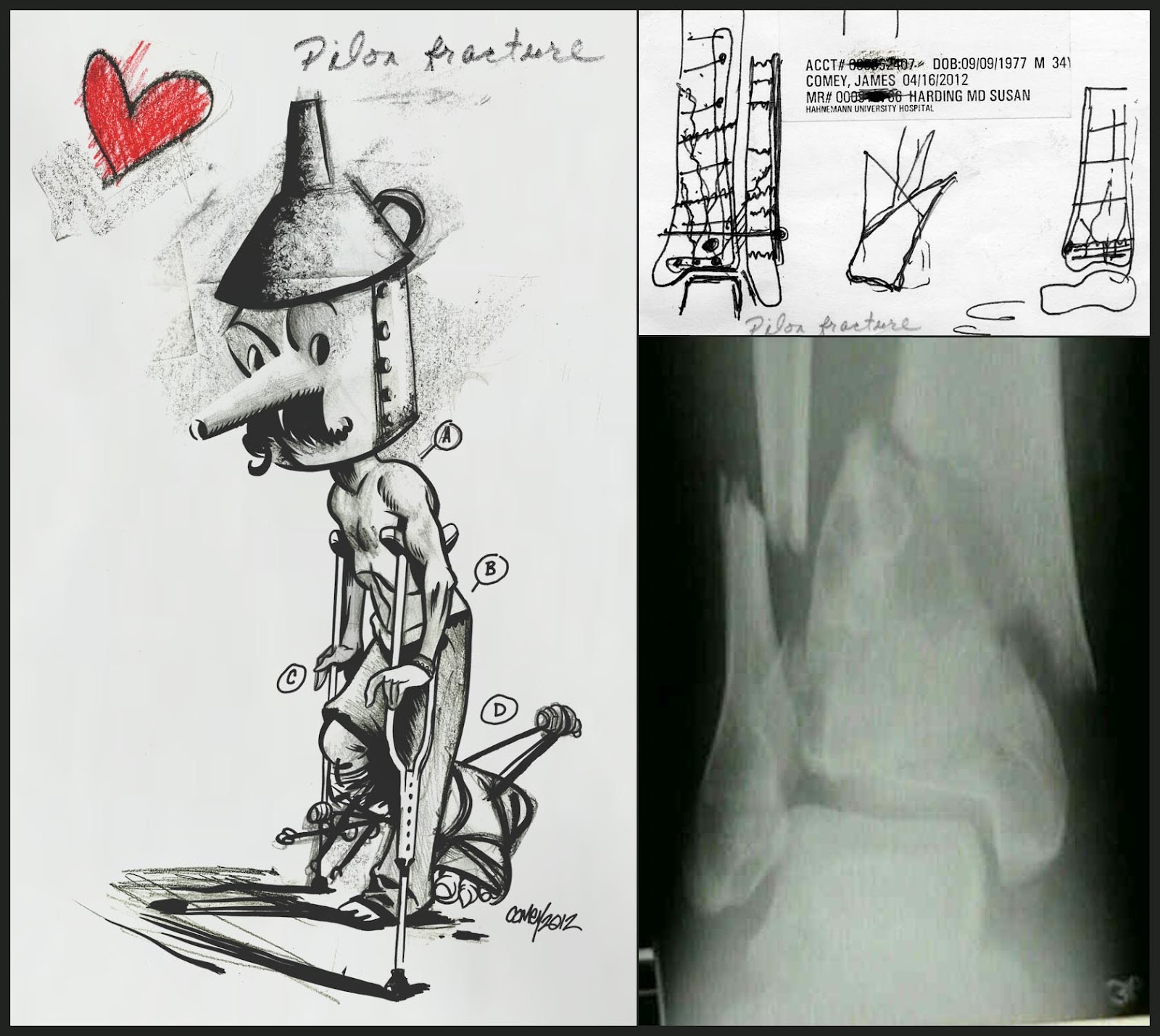
The Return of the Tin Man


Last Tuesday, at Hahnemann Hospital in Philadelphia, I met the Tin Man. He had been in hiding for over a decade. I had hoped that I wasn't going to ever see him again, but fate is fickle and has its own determined mind.

I met him for the first time when he was only five. He had been exploring the notion of gravity and falling and the possibilities of bouncing on hard surfaces. He didn't become the Tin Man that day. His elbow was only encased in plaster, a slight but painful fracture. Jungle Jim's and playrgounds and the allure of testing gravity, however, made my wife and me hyper vigilant.

Thirteen years later I received a phone call on Labor Day. I was told to report to a field close by. There had been a accident. When I arrived at the field, at the same time as a local police officer, I saw a crowd in the middle of the field. The police officer was a giant, maybe seven or eight foot tall. His shadow blocked out the Labor Day sun as the two of us walked to the crowd. He saw the individual sitting on the ground before I did.

"Oh sweet Jesus," he said, and his legs became wobbly.

I wondered if I should try to steady his massive frame when I saw the teenage boy on the ground. His left arm looked terribly wrong. Instead of extending out in a linear line from his elbow, as most human arms do, his lower arm was shaped like a U. His wrist was curved back around, almost even with his elblow.

The arm required lots of tin and steel, plates and screws. Scars remain today, two angry lines like railway tracks with spike marks heading nowhere.

In college, it would be the Tin Man's left collar bone. A playful wrestling match with a friend went wrong. His body found itself in the air again, and, when he crashed, the collar bone went from a horizental support beam to a vertical compass point. It would take a plate and many screws and tin to keep the compass point down. Today, when the temperature drops low, the plate, still there doing its duty, reminds the Tin Man of how cold life can be.

Various finger breaks and sprains have popped up now and then, but only splints were needed. It looked like the memory of the Tin Man was going to finally fade away. It looked like my son, Jim, was no longer going to be in need of metal supports and struts. The days of scaffolding, both external and internal, were over.

And then, last Tuesday, Jim was tempted once more by the siren song of gravity. While retrieving a soccer ball from a garage roof, he caught his foot 12 feet above the ground and began to fall to earth. Only this time, it wasn't his elbow or his arm or his collar bone that was on a direct collision course with earth. It was his head. Somehow, miraculously, he managed to almost right himself when his right foot and ankle made contact, taking the full weight of his body.

The trauma surgeon at Hahnemann Hospital called it a pilon fracture. Rods now extend outward from his skin below his knee to a super structure down his leg to a rod that runs right through his ankle. Eight screws are holding his lower fibula bone together. A second surgery will involve securing plates along his tibia to fix the shattered bone there. More tin has now been added to the Tin Man.

In The Wixard of Oz, the Tin Man journeys to the Emerald City to ask the all powerful wizard for what he desires most: a heart. But, the all powerful Wizard of Oz tells him, "A heart is not judged by how much you love, but how much you are loved by others."

In each of these gravity-defying mishaps, Jim has discovered that pain can be sudden and terribly real, courage is needed to put parts back together again, and the true nature of love is when it's freely offered by others, expecting absolutely nothing in return.

Copyright (c) 2012 by James Hugh Comey

The picture at the top of the blog needs the following explanation:
The sketch on the left was drawn by Jim to indicate where metal has been added to his body and to show the external fixator. The sketch on the top right was made by Dr. Susan Harding, the trauma orthopedic surgeon after Jim's first surgery, to explain the amount of work done and still needed on his right leg. The X-ray shows what a pilon fracture looks like. Jim's was 50 times worse.


Sunday, April 15, 2012

A Boy and a Man on a Cross

My enovel, Uncommon Glory, now has its own Facebook page: http://www.facebook.com/#!/UnCommonGlory. Please visit the site, click Like, and help me to spead the word about this coming of age story about a boy and a man on a cross, available from Amazon at http://www.amazon.com/Uncommon-Glory-ebook/dp/B006MINMJA.

Monday, April 9, 2012

Bang in the Face

Yesterday was Easter Sunday, 2012. Easter is a time of family and candy and laughter. It is a time of looking forward with anticipation, and, if you are old enough, remembering with a melancholy heart.

My granddaughter, Maeve, a five year old budding philospher and origami master, surprised us over the weekend by suddenly asking, "What is your favorite holiday?"

Each family member thought some and then declared their favorite day. Thanksgiving for autumn food and colors, Christmas for presents and lights and music, the 4th of July for picnics and fireworks, Halloween for dress up excitement. When Maeve asked me, I said, "I'll get back to you." Each memory that I invoked included my parents. Both are gone now. I am a 64 year old orphan.

My mother's absence was especially felt this past Easter weekend. On Good Friday, we are reminded of the scourging of Christ and the desertion by his own disciples. The fear of torture and crucifixation made his most devoted followers hide or deny any connection to him.

There was one, it seems, who did not hide. His mother.

Throughout His mocking and brutal beatings by a foreign power, she looked on. At the time of His death, nailed to a cross, His mother was there. I cannot begin to imagine the heart rendering pain that she suffered that day. Nor can I imagine her surprise, fear and then joy to discover that the son that she lost was with her again.

That's not completely true. My own mother died, and then she came back to me.

In 1996, my two brothers and I were called by my father to come to Florida. My mother, after a long illness, had gone into a deep coma and was in the intensive care unit of a hospital. The doctor met us outside my mother's unit and told us there was no hope for recovery. She was on a respirator that was forcing her to breathe. Her major organs were breaking down, including her kidneys. She was dying. The 4 foot 11 inch dynamo who my brother John called "Queen" because there were few who could stand in her way, was almost unrecognizible. Her iron will, winning smile and sharp tongue were gone. In its place was a swollen body that was being kept alive by a machine that was inflating her lungs.

My father, brothers and I agreed that this semblance of "aliveness," made possible by the respirator, was not something that she would ever want or tolerate, and we had the respirator removed. The doctor told us, without the lungs functioning,  her brain activity would cease after 20 minutes or so. There was an EEG machine to the right of her bed on a shelf.

How do you say goodbye to your mother? We were told that she might be able to hear us. One by one, we came to her ear and told her that we loved her, and thanked her for all that she had done for us. As we spoke to her, our eyes stayed locked on the blips of the EEG monitor. Twenty minutes passed and the blips continued. There was no breath, no movement. We tried to sound brave; we tried to hold back our tears.

At 30 minutes, the EEG flatlined. After a minute of the buzzing from the EEG machine, my brother John said, "She's gone. She's dead."

I leaned down close to my mother's ear and said, "The angels are here with you now, Mother."

And the EEG began to blip again.

My brother Dave said, "Holy Shit."

I looked at the monitor and at my mother. I said, "You are one tough lady, and we love you with all of our hearts, but it's time for you to sleep now, Mother."

The EEG flatlined again.

Spring and Easter are a time of renewal and rebirth. And sometimes, it takes a five year old granddaughter to help you remember the incredible power of love.

Langston Hughes wrote: "I stuck my head out the window this morning and spring kissed me bang in the face."

I think my favorite holiday is spring.

Copyright © 2012 by James Hugh Comey

Saturday, February 18, 2012

The Genius in My Back Yard


There is a genius in my backyard. She is 30 feet tall and possibly the smartest creature I have ever known. She loves the winter and the cold, saving her finest attire for the months when my feet freeze and my hands turn blue. Over the 35 years that I have known her, she has sheltered hundreds of finches and mockingbirds and cardinals. Her bark is smooth and her leaves are as sharp as tiny knives, but I sense that she doesn't have a single ounce of meanness in her.

She is a holly tree, and she is the most remarkable and clever creature. Without moving an inch from her roots, she is fertilized year in and year out by the stout and lumbering male holly bush that lives around the far corner of my neighbor's house. Squirrels, chipmunks and birds of every color visit her welcome, safe, dense branches after larking in my neighbor's yard. Her thick branches are a safe haven for the bustling life that brushes up against her with their fur and feathers. The air often blows from the east, catching the pollen that will stimulate the berries that appear in the hundreds by November. By December, she is a glory of brilliant red dots against emerald green that radiates against the drab and grey landscape.

So, without budging an inch from her solid and safe spot in the right rear section of my back yard, she is now heavy with fruit and potential new life. What good is that, you may wonder, when she is imprisoned by the deep roots that hold her captive? How can this handsome, tall tree cast its offspring out into the world when each berry clings tightly to its mother's arms?

She flies. Wood and leaf, bark and berry transform into a frenzy of wings and beaks. Every year, for the last 35 years, this brilliant holly tree becomes a blur of hunger-crazed, male robins. By the hundreds, they descend from all directions in mid February and gorge themselves with her sweet fruit. They then fly, most often to the front of my house and my elephant-barked maple tree. There, they poop red rain upon all things below. My two cars, unless I move them very quickly, loose their green and silver colors, and become a blotch of red, looking as if a crazed paint baller was trying to write hieroglyphics. For the last three weeks, both of my cars have been parked around the corner, safely away from any tree branches. Three times, I thought I was safe and brought them back to my driveway. Three times, I've had to scrub large blotches of red from their roofs and windshields.

And, all of this time, while the robins drop their red rain and I scrub off my car, the rain and snow and wind have been delivering my holly tree's seeds to lawns and front yards and woodlands that the tree can't even see. Without budging an inch, she has figured out how to make more of herself. This arboreal female has conquered the air by selflessly offering gifts to those in need. Her mobility stretches out in all directions, even though she never moves. The paradox of her plan is startling in its simplicity.

I have marveled year after year at this genius in my backyard. When my own worries and fears and needs seem to overwhelm me, I think of her and her calm and elegant approach to life. "Listen to the trees in their sleep," she whispered, as he lifted her to the ground. "What nice dreams they must have." (Anne of Green Gables)

Copyright © 2012 by James Hugh Comey

Tuesday, January 24, 2012

Boomers in a Digital World

Greg Dobbs and David Henderson, two award-winning newscasters and producers, have been kind enough to post my article about the birth of my coming of age enovel, Uncommon Glory, on their web magazine, BoomerCafe.com (http://www.boomercafe.com/2012/01/24/its-worth-putting-memories-on-paper/). A digital book with a digital cover, sold through a digital bookstore, is now being promoted in a digital magazine for people who were born at the dawn of computer technology.

Sounds like wacky science fiction to me. :)

Thursday, December 15, 2011

Uncommon Glory

When I was in third grade, my brother, John, and I watched a movie from a graveyard. The graveyard was behind St. Charles Church in Drexel Hill, PA. We had both just served 40 hours devotion inside the church, a job that required us to kneel ramrod straight for an hour before the right side altar of St. Joseph. On the side altar was the Monstrance and in the Monstrance was a consecrated host. It was Holy Saturday, 1955. I was eight years old. My brother was ten. After our duty, he convinced me to sneak behind the church with our surplus and cassock tucked high so as not to rub against the dark tombstones. He wanted to try and glimpse the large screen at the Family Drive In tucked away in a hollow down below us. It was a Saturday night, and the drive in was packed.

We couldn't hear anything because each car had its own speaker mounted on its window frame. But it was a clear spring night, and I could see the entire screen from our vantage point. I have never forgotten what I saw. A man with a beard and a scar down his face was lashed onto a great white whale. Men in long boats were attacking the whale, stabbing it with harpoons. The man lashed to the whale appeared to be waving, his one arm raising and falling. That night, tucked within the silent landscape of a spooky graveyard, I watched Captain Ahab and Moby Dick in their dance of death.

I have never forgotten that image. Some years back, it became the opening scene of my coming of age novel, Uncommon Glory. Altar boys and drive in movies and the joy and angst of that time period flowed out of my fingers into this story. Conscience and caring, families and friendships found their way onto the pages. Rock and roll, slow dances and coon skin caps bubbled up from my memory. Quirky teenagers and adults, murder, revenge and redemption all came together into this sad and funny story.

Two literary agents tried to sell the manuscript. There were no takers. Editors didn't know what to make of it.  Faith and hope were backbeats to the pulsating rhythms that moved through the chapters. There was a talking statue, a psycho altar boy, and a singer appearing on Ted Mack's Original Amateur Hour (the 50s version of American Idol). The book didn't fit into a publishing niche.

Oprah featured a book a couple of years back on her TV show. I read the book, liked it, and then contacted the writer's agent. The agent agreed to read Uncommon Glory but didn't respond for the longest time. I finally called her.

"I was putting off talking to you because I'm at a loss," she said.

"A loss?" I asked.

"A loss," she said. "I love your writing and I love the story, but, for the life of me, I can't think of a single editor that I can sell it to."

When James Cameron was interviewed after releasing his highly successful film, Avatar, he said," I came up with the script for this film in 1994, but it was not possible to make the film then. I had to wait for the technology to catch up before I could put it on the screen."

With the new technology of ebooks and digital publishing, I am now able to finally release Uncommon Glory. Patience and persistence have driven me not to despair in trying to bring this story to readers. Tonight, the book has been released through Kindle Books (http://www.amazon.com/Uncommon-Glory-ebook/dp/B006MINMJA/ref=ntt_at_ep_dpt_1).  I hope to release the book soon through Barnes and Noble's Nook. My son, Jim, a professional illustrator, designed and illustrated the cover.


He has perfectly captured the mood of this American Graffiti meets A Prayer for Owen Meany story. His promo banner adds even more.


It has taken a long time for this novel to be born, but I couldn't be a prouder parent, both of my son's art work and of this uncommon story about loneliness and hope.

Saturday, October 29, 2011

Seeking the Mind, Touching the Spirit

Twenty five years ago, I began a quest. I was 39, had been teaching for 17 years and writing off and on for the same time period. I had been watching high school kids struggling with school and parents and broken emotions. I had been watching adults around me tripping over divorce and alcohol and frustrated careers. I wondered if there was something that could help people find a path less crooked. I began to search for a natural, non-addictive aid that could help me, my family and others to become unstuck from bad habits and self-defeating thoughts. I sensed that the answer to positive change was not in a pill or a bottle. It was in the mind. But, how to reach it? How to get past years of negative thoughts that had carved ruts into our psyche? How to offer new choices for reflection and behavior to someone who was feeling hopeless and helpless?

My quest led me down several roads. One of these was hypnotherapy and NLP (Neuro-Linguistic Programming). I began training with psychologists in PA and NJ to learn how to gently focus the mind on ways for achieving reasonable and desirable changes. Over three years I attended small seminars and international conferences where practitioners from Brazil to Italy to Canada shared their strategies. I became a registered hypnotherapist and a certified Master Practitioner of NLP. For four years, I offered consulting and counseling to several hundred clients and corporations. The needs ranged from improving communication skills for a thriving Philadelphia business to helping a woman deal with terminal cancer. If I hadn't taped the 60 minute trance sessions so that clients could listen in the future for reinforcement, few would have believed that more than several minutes had passed since I asked them to close their eyes. Buddha said: "The mind is everything. What you think, you become." I saw evidence of this over and over again, then and now.

Another road that I followed, and follow still, was seeking the internal spirit that lies in each of us. In Eastern cultures, this internal spirit or energy is called prana, chi and ki. I began to study Aikido, a Japanese martial art founded by Morihei Ueshiba. I attended a dojo in Philadehphia for a year until I broke my left collarbone one Sunday morning at class from a misplaced grand roll. Although I left Aikido, I embraced its powerful principles. I had not yet felt ki, the energy that the sensei (teachers) at the dojo spoke of often, but I believed that it existed. I saw tiny, third degree black belt women throw huge men across a mat with little effort. They touched spots on my arm to block my ki that made my legs buckle, and they threw themselves high through the air with complete abandon and never hurt themselves.

I began to study Tai Chi and Chi Gung with several sifu (teachers). Tai Chi is a form of moving meditation. Chi Gung is standing meditation. Both involve rhythmical, deep breathing. Breath is another translation for the word chi. Tai Chi, although beautiful and slow, is also a very powerful martial art. Lyrical names of movements like Snake Creeps Down and Playing the Guitar can translate into bone crunching strikes and joint pressures. After a decade of practice, I began to feel chi in my hands. It often felt like electric ants in my fingers and palms. After another five years of practice, I began to be aware of the skin temperature of people around me. Once, at a Chi Gung seminar, I was asked to place my hands near the body of a complete stranger in attendance. We were tasked with trying to feel any noticable differences of skin temperature. I felt nothing of significance until I placed my right hand over his right wrist. I quickly removed it because I felt a hot, almost burning sensation. When I asked him if he had any medical concerns that involved his right wrist, his eyes grew wide. "I have surgery scheduled for carpal tunnel syndrome on my right wrist tomorrow. How the heck did you know that?"

My quest continues. As health issues surface, as parents pass away, values change. There are new roads to explore and new wisdoms to discover. As Elisabeth Kubler-Ross explains: "People are like stained-glass windows. They sparkle and shine when the sun is out, but when the darkness sets in their true beaurty is revealed if there is light from within."

Copyright © 2011 by James Hugh Comey

Sunday, October 23, 2011

Until They're Not

In September 1969 I began my education career. I was 21 and looked 16. I was teaching English to 17 and 18 year old seniors at Kennett Junior/Senior High School in Kennett Square, PA.  A moratorium peace demonstration against the war in Vietnam drew massive numbers in Washington, DC and other cities. Butch Cassidy and the Sundance Kid and Easy Rider were playing at the drive-in.  A little, four day festival in Woodstock, NY had drawn 350,000 people only the month before, and a new TV show called Sesame Street was on National Educational Television (later to become PBS).  Jimmy Hendrix and Led Zeppelin and Simon and Garfunkel were on the radio. Lloyd Alexander (who would later speak to one of my classes at Upper Darby High School and go on to endorse my writing) won the Newbery Award for The High King. A postage stamp was 6 cents, gas was 32.9 cents a gallon, and the median household income was $9,302.

It was a time of excitment and worry and change. Hair, including mine, was growing longer. Skirt lengths were growing shorter. I was spanking brand new and eager to try untried things.

One day, I presented this quote from Jules Verne in class: "Anything one man can imagine, other men can make real."

"Your assigment," I said, with all of the confidence I could muster, "is to think ahead 25 years and come up with a new invention or a radical change on a current one. It has to be feasible and doable in 1994. You'll think through how it will work, who might buy it, and what it might cost. You'll have graphics or a working model, and you have to present your invention orally to the class."

I had no idea how this assignment would fly. I met with each student in advance to approve their original concept, and helped them, as best as I could, with their research. There was no internet then, although that's not quite true. ARPANET, the precursor of the internet, came online in 1969 to connect UCLA, Stanford Research Institute, the University of California, Santa Barbara, and the University of Utah.

Forty two years later, it has been my fascination and delight to remember the incredible inventions that hundreds of students at Kennett Junior/Senior High School, Upper Darby High School and Strath Haven Middle School presented to me and their peers. Many were prophetic, insightful and remarkable in their scope. These came from honors students and struggling students. They worked solo with me or had help from parents, grandparents and neighbors. Their drawings were complex or simple. And, sometimes, their audiences hooted with laughter at the seemingly outrageous concepts that these student dreamers were proposing to them.

I don't know if any members of those classroom audiences will recall those speeches, but, if they do, they won't be laughing now. Here are some of those seemingly implausible ideas that I heard for the first time from middle school and high school kids decades before they came to pass:

* Build a larger version of a toy, remote controlled airplace and attach video capability for recon on military missions in remote area. When the student inventor suggested arming them for combat missions, the class suggested that he had some screws loose. UAVs (Unmanned Aerial Vehicles) have played a major role in Iraq and Afghanistan for the last 10 years, as well as saving countless lives in wilderness rescues.

* Construct a rail on which a train would glide quickly and with little sound on magnetic levitation. There would be no conventional engines, no standard fuels, and no side rail or overhead wires. A number of students declared that this was impossible to pull off and would never happen. I wonder if any of them have ridden on the Maglev trains in Europe and Asia.

* Replace silicon chips in computers with light-driven sources and conduits of information. This was 18 years before I had heard of FIOS. And, the world's first photovoltain circuit was invented last year at the Univ of PA.

* Develop a steering system that would allow automobiles to assist in parking themselves in tight urban settings. Toyota introduced the IPAS (intelligent Parking Assist System) in 2004.

* Place wind collectors above signage on interstate highways so that tractor trailers, buses and other large vehicles would provide a constant source of wind energy to convert for lights on the road. Not yet invented, to my knowledge.

The list goes on and on, with many students over the last several years predicting holographic images projected from classroom walls, time travel to places of historical interest, and communication devices embedded inside our bodies. Electronic readers for E-Books, IPhones, and IPads are not revolutionary to them. They anticipate that their backpacks will completely disappear with DVDs and E-Books replacing their heavy textbooks. On-line college courses are standard fare, and cyber schools are commonplace.

For me, it is all revolutionary. The lastest issue of The Authors Guild Bulletin is devoted to apps. Before that, it was about the influence of digital publishing on conventional paper publishing. Borders bookstores are no more. Amazon and dozens of other sites offer free digital publishing with attractive royalities. The very length of writing is being influenced by the size of the screens of cell phones. Publishers and literary agents are scrambling to make sense of this reshaping of the delivery of text to readers. The fact that minutes after I type this, this blog can be read by anyone in the world with access to the web, is mind blowing to me.

And, I am delighted by it! In the very near future, I will be releasing my first digital book. My son, Jim, a MICA graduate and prize winning illustrator, is creating the cover. I hope to follow this first digital book with many more.

Had someone told me in 1969 that I would be communicating with people from Canada to China by electronic means through a digital format, I, like many of my former students, would have laughed at them. But, as Jean-Luc Picard, captain of the fabled USS Enterprise, said: "Things are only impossible until they're not."

Copyright © 2011 by James Hugh Comey

Friday, September 30, 2011

More to Be Prized

There is a large maple tree in my front yard. It has been there since I moved to this house 35 years ago. Its bark has always reminded me of an elephant's wrinkled skin. Its leaves in the fall have held the colors of burnished gold and apple reds. It has drawn neighbors and morning walkers and strangers with fancy cameras to marvel at its height and strength and beauty.

But, over the last year, it has also had problems. June, a year ago, a violent wind shear that tore through Chester and Delaware Counties, snapped a mighty branch and hurled it atop one of my cars in the driveway. It only kissed the roof of the car, but it took powerful men with powerful chain saws to free the car from the embrace of the huge branch. Several months later, during a storm of lashing rain, another branch snapped off 40 foot or so above my other car, and fell like a javelin. Fortunately, nobody was beneath it or they could have been seriously hurt. Unfortunately, the branch struck the roof near the back with such force that it shattered the rear window. I had to quickly throw a tarp over the gaping empty space or the inside of the car would have been flooded.

Worried I could on longer trust the tree, I asked arborists to come and evaluate it. The first said, "Cut it down. It's old and worn out. More limbs will fall. It's now a nuisance and a danger. Cut it down." The second arborist came and said, "This is a beautiful maple, one of the finest I've seen. It's probably around 75 years old or so. It gives you shade and moist coolness in the summer. It has been the home of generations of wildlife. It does need some assistance now. You need to seriously thin and top the branches and have several cables strung from the trunk of the tree to the heavier outer limbs for support. You also need to have two iron rods driven through the base of the tree so that it will have better structural integrity. It's an older tree, but it's a tree worth saving." Ironically, the cost to cut down the tree was almost identical to the cost of rehabing the tree.

My wife and I had to make a decision. If we removed the tree, the problem was gone. No more worries during a storm. No further maintenance down the road. This was the most logical and rational cloice.

But, logic isn't everything. And reason doesn't account for the heart. My daughter, Jennifer, and son, Jim, grew up playing in the shade of the maple tree. My grandgirls, Wynnie and Maeve, run around and around the tree chasing each other when they visit from the concrete landscape of D.C. Sure no grass will grow beneath the summer shade, but delicate moss, not unlike the ground cover of the Irish countryside, has claimed my front lawn for its own. And, perhaps most importantly, I realized that I had a deep kinship with the tree. Both of us had weathered many storms over the years. And, it reminded me of my father, who, when he was 89, was brought by my brother, John, and I from Florida to PA so we could care for his aged body and mind. He died when he was 92.5, a once tall, 6'6" tree of a man with his three sons at his side.

The maple still has a lot of spunk to it. It took three tries and many hours for burly, seasoned workers to drill and drive iron rods through its trunk. Tiny, new branches are lifting up to the sky where thicker branches were shorn. Morning walkers are staring up at the marvel of the strung cables, like circus high wires. And the leaves, as they fall now onto the moss with the coming of Halloween, will grow again in the spring, shading the lives of my family.

The maple tree, with its wrinkled skin and proud stance, has been our companion and friend for the last 35 years. It has watched over us during happy times and times of grief. Although some may not understand, or may even scoff at my sentiment for something aboreal, I am in agreement with Thomas Aquinas: "There is nothing on this earth more to be prized than true friendship."

Copyright © 2011 by James Hugh Comey